
Housing Improvement in the Green Impact Zone®
A drive through the neighborhoods of the Green Impact Zone illustrates the area's serious challenges with abandonment. Approximately 25 percent of the properties in the zone are vacant lots, and another one-sixth have vacant structures. Fewer than half the homes are owner-occupied. Almost 20 percent of all mortgages were delinquent over the last two years. Median home prices for the area are less than $30,000.
Strategies for addressing housing issues in the zone include rehabilitating existing homes, developing new housing on vacant lots, removing dangerous buildings, working with real estate agents to increase home sales in the zone, and working with landlords and absentee owners to improve property maintenance.
2013 Urban Homes Tour
Join us for the fourth annual Urban Homes Tour on August 17, 2013. Read more about the event.
2012 Urban Homes Tour
We recently completed our third annual Urban Homes Tour in the Green Impact Zone. Read about it on our blog.
Housing Planning and Redevelopment Projects
Following a competitive bid process, the Green Impact Zone selected APD Urban Planning and Management, a minority-owned firm based in Jacksonville, Fla., that has experience working in the zone, to offer technical assistance and expertise on housing issues. With funding from the U.S. Department of Housing and Urban Development, through MARC's Sustainable Communities Regional Planning Grant, APD will work with neighborhood leaders and other stakeholders to develop plans for and implement at least two demonstration projects in the zone.
Neighborhood leaders and CDCs identified several potential projects, including redevelopment of Bancroft School in Manheim Park; Ivanhoe Model Blocks, the Blue Hills Housing and Contractor Incubator at 5008 Prospect, Bright Lights redevelopment and several infill redevelopment projects. ADP will help advance some of these housing projects or others that might be identified over the next two years, resulting in new housing investment in the zone. For more information, see the zone's Housing Strategy handout.
Data and Research
As a first step, MARC contracted with the University of Missouri–Kansas City's Center for Economic Information to collect data about current conditions in the zone.
In February 2010, UMKC published a report that includes results of a property-by-property windshield survey of housing and infrastructure conditions; an analysis of the historic character of the zone; and property, crime and demographic data provided by Jackson County, the city of Kansas City, Mo., the Kansas City Police Department and the U.S. Census Bureau.
Currently, UMKC is working on a second report based on a windshield survey and similar data for business properties in the zone.
The university houses the data on an interactive website, http://kc-csrv-ceiweb.kc.umkc.edu/greenimpactzone. The site allows users to generate maps and tables that cover a wide variety of conditions in the zone at the parcel level, including roofs, foundations, sidewalks, curbs, landscaping, litter and more. The Center for Economic Information has provided space in a computer lab on the UMKC campus for neighborhood leaders and youth to become familiar with the website and learn how to use maps and data to help facilitate improvements.
Bancroft School Renovation
With the Missouri Housing Development Commission's vote to approve Low-Income Housing Tax Credits, the long-awaited Bancroft School redevelopment project will become a reality. The $14 million redevelopment will include 50 affordable housing units — 29 in the remodeled school building and 21 in new townhomes to be constructed on school grounds. Partners include the Make It Right Foundation, the organization founded by actor Brad Pitt to address housing needs in New Orleans after Hurricane Katrina, which will donate $2.3 million to the project; a local developer, Dalmark Development Group; Kansas City, Mo., Neighborhood Housing Services; BNIM Architects; the Historic Manheim Park Neighborhood Association; MARC; and the Green Impact Zone. Learn more>
 Donation of Foreclosed Properties
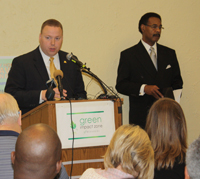
Wells Fargo bank has announced plans to give back to the community by transferring ownership of 23 foreclosed homes to the Ivanhoe Neighborhood Council Foundation, which will oversee rehabilitation of the properties. Tony Julianelle, area sales manager for Wells Fargo Bank, shown at right with U.S. Rep. Emanuel Cleaver II, also announced a cash donation of $7,500 per home — a total of $172,500 — to help with rehabbing and remodeling the homes for Kansas City families.
Neighborhoods in the Green Impact Zone have a lower-than-average rate of owner-occupied homes — a problem that has only increased with the recent rise in home foreclosures. This donation, helped facilitated by Green Impact Zone staff, prevents foreclosed homes from sitting vacant or being sold to out-of-area investors. See the full news release»